Monday, 23 May 2011

We catch up with Todd Fuller, winner of 2009 Lloyd Rees Awards

It's been 2 years since Todd Fuller won the 2009 Lloyd Rees Memorial Youth Art Award and Centrehouse has been keeping an eye on this very talented and busy artist. We spoke with him earlier in the week to find out how he spent his $5,000 prize money and how the award contributed to his art practice.

.           CH: Todd, you won the Lloyd Rees Memorial Youth Art Award Prize back in 2009, how did the prize money help support your art practice?

        TF: Not long after winning this award I was notified that I was the recipient of the Storrier/Onslow residency to the Cite Des Arts in Paris through Friends of the National Art School and the National Art School. With this in mind I invested the money and then used it to help pay for some of the expenses associated with the residency. Strangely Paris was cheaper than Sydney so the prize money went quite a long way. It helped pay for short trips to London as well as new animation and drawing equipment that I used while working throughout my time at the cite`. I also found books in Europe to be wonderfully affordable so it has helped me establish a useful reference library full of literature and artists that I have brought back to my studio in Sydney.

2.       CH: The art work that won this Award was the animated drawing Watt Art? With Permission and I noticed that you have made a number of other animated drawings since, can you tell us a little about your process and what the animation means to your work?

      TF: I think that cartoons have had a large impact on not only me, but my generation of young artists. In the nineties there was a morning ritual in which animation and cartoons accompanied the morning breakfast routine, they were engrained in our daily life. When I was young I was always doodling these cartoon characters, who are essentially moving drawings, later in life I worked in cartooning so it seemed logical that I should attempt to make my drawings (within my fine art context) move. I also spent a great deal of my teenage years studying dance so with this in mind it is a wonder my drawings were not moving sooner.

      When I worked in cartooning I would draw on stage in front of crowds of children, once you use nothing but a few lines on a page to silence a room full of kids you realise the sheer power of drawing. Some people think about drawing as a secondary act which supports other disciplines such as painting and sculpture but for me drawing is the core to everything!

      This is why I love animation, it is a celebration of the magic of drawing. It is a process in which every single mark is savored and given due attention, it is not just about the static resolved result but rather the entire process and journey. Animation allows every mark, mistake, realisation and moment to be given some attention. When I animate, I photograph every single action, every line of charcoal, splash of ink or stroke of paint and every scrape of the eraser is recorded. It takes a great deal of time and an intense dedication to the process. It is almost a ritualistic dance back and fourth between the canvas and the camera in which looking and re looking helps the drawing rapidly progress. Once I have a series of photos they are then sequenced and edited to fill a block of time which ultimately becomes a film.

      My early animations were about exploring drawing and then I moved onto using it to tell stories. I try and use animation to develop a narrative without concealing the marvel that is drawing. Drawing remains the silent star of the stories I weave. Even when I sculpt it is derived from the logic of observational life drawing. I think this is why I think of animation and drawing as the ultimate story teller.

3.       Winning the Storrier/Onslow residency to the Cite Des Arts in Paris from the Friends of the National Art School  & NAS must have been amazing. What did you work on over there and how do you think Paris impacted on you art work?

        Months after returning I am still processing the amazing experience and wonderful people I met in Paris. I learnt so much about myself as a person and as an artist and I really struggle to articulate the extent of my gratitude and personal growth while in Europe. I did not treat the experience as a holiday and adopted a disciplined approach to the time and tried to do all that I could. That said there was so much to do and see that it is really impossible to do it all. Paris allowed me access to the old and the new of the art world. I would draw from the masters but also experience the latest and greatest of the contemporary commercial art world. I added poses, techniques and characters to my repertoire.  

        One of the biggest impacts has been on my career, this period showed me how small the world truly is, especially the art world! It gave me access to information and opportunities as well as the confidence to begin showing my work elsewhere in the world. As a result I have recently been included in group shows in England and America. Traveling made me question my work and how it sits in an international context, it also made me more aware of the Australian context from which I make my work.

4.       You are involved in a number of curatorial projects, like Sculpture in the Vineyards and now a new project with the Cessnock Regional Gallery. Can you tell us about these projects and what you find interesting about the curatorial process.

        I believe engaging in as many aspects of the industry as possible and that each has something to teach. I love to write and I also work as an educator while curating and of course art making. Each of these processes continues to strengthen my artist practice as well as each another. I really love the Hunter Valley and Newcastle, they are where I grew up and I love the diversity and strength of work taking place up there. 

        Cessnock Regional Gallery is a very unique institution which offers the Cessnock community access to some wonderful art and artists. The Gallery is relatively new so it offers this area access to something which I did not necessarily have when I was growing up there. With this in mind I am delighted to be apart of the CRAG team. I feel like I am making a difference and look forward to continuing my work through the recently awarded Sidney Myer Curatorial initiative mentorship program, which was administered by NAVA. The show we are currently developing will open in August and is focused on our regions mining heritage. It will bring together contemporary art and historical artifacts. It is exciting to be exploring our history in detail and we hope to present an exhibition which will really instill some pride in our regions fascinating history.

        Sculpture in the Vineyards is a completely different endeavor and one which I am blessed to be apart of. I am joining an amazing team and am already learning a great deal from my colleagues. This particular sculpture prize is one of my favorites and I think it offers some unique opportunities for sculptors. The outdoor exhibition is three months in duration and spread across an array of breath taking sites in Wollombi. I really encourage any aspiring sculptor to check our the competition at http://www.sculptureinthevineyards.com.au/ .

        I love the curatorial process for a variety of reasons. Coming to curating from an art making background puts me in a good position to empathise with the artist I work with to help ensure that their work is shown in the best possible manner. I am only twenty two but I love the places that curating is taking me and the people I get to meet. It is great to step out of my own way of thinking to work with other artists to try and give strength to what they are saying or doing. I am still quite new to curating and am more than aware that I have a great deal to learn, but am excited about the projects I have ahead of me.
        
5.       Your last exhibition with the Brenda May Gallery was a group show of figurative sculptures, featuring men in bunny suits, made from terracotta, ink, wood, acrylic and astro turf, can you tell us what inspired this work and what are you planning next?

see this website on the Brenday May Gallery for images from this exhibition.
My work and the stories it tells are currently concerned with masculinity but there is a lot more going on in them than this. I have an ensemble of characters which have been developing over the last few years. I utilise the characters in different ways to convey a variety of meanings but I am always aiming to evoke humour, pity, speculation and contemplation. I have a pair of lovers named Billy and Elliot who are a coal miner and a ballet dancer, they are both large, bald and round. There is also a tin robot, a petrified bather, the fallen angels and of course my men in bunny suits. I let my imagination go wild with their narratives, and over time their tales are getting more layered and are exposing more and more of my own personal story and personality. Some of these pieces are choreographed to offer thoughtful moments of contemplation while others are designed to provoke a deep belly chuckle or evoke a sense of theatrical drama.

 The men in bunny suits come from an animation titled 'burrow' (feel free to check it out at www.brendamaygallery.com.au), it is a bizarre story about a man who finds comfort in a bunny suit after losing a partner who also happened to wear the bunny suit. The bunny suit is flamboyant and obvious but innocent guise which alludes the to softer more tender sides to these very male plump characters. However the suit is only worn in private, in the mans room or in a park late at night when he dares to sneak out. I have taken this bunny suit motif a step further and begun flocking my ceramics so that their suits surfaces are actually soft and sensual. 

From this particular animation evolved an on going narrative about difference and belonging. A fat bald man continually emerges who wears the bunny suit in defiance of the nine to five practical world. He finds others like him but even when paired on in a group of fat men in bunny suits, he finds himself very alone. This character somehow locates a friend and together they brace themselves against the world. This was the preface to the 'together' sculpture from 'sculpture 2011' at Brenda May Gallery. 

 As for What is next.....

There are plenty more characters waiting in the wings but they won't emerge until they are good and ready. 
The most important thing I am currently planning is my next exhibition with Brenda May Gallery. It will be my first solo show with the gallery so it is shaping up to be extremely exciting. The show will include animation, drawing and sculpture as well as some integrations of the three mediums. I have designed the exhibition like a good soapie, it has characters you will love and others you will love to hate, twists and turns, moments of hope and others of intense personal struggles, drama and suspense and at the end a cliff hanger that will leave you wanting more....I hope. 
This exhibition will be open to the public from the 2nd of August while drinks with the artist will be on Saturday August 6th.

Sunday, 22 May 2011

Applications Open - 2011 Lloyd Rees Memorial Youth Art Awards

It's time to think about your work to submit for the Lloyd Rees Memorial Youth Art Awards. You've got just over 3 months as applications are due 19th August.The theme is open to what ever subject you would like to paint, draw or print. We are encouraging all artists to submit up to two artworks this year and it is open to those artitsts aged 18 - 28 years and live in Australia.


You can also sell your work at the exhibition (if you do not win the Aquisitive Prize that is) or if you prefer not to you can always put not for sale. We suggest that those not wanting to sell their work write not for sale, rather than putting an inflated price on the work.

It's really important to think about hanging and leaving enough time to either get your work framed or place strong d-rings on your canvases so we do not have to hang it from the frame as this can damage your work an important if you want to sell.

With over 60 entrants last year, there is a great opportunity to not only have your work shown and exhibited to an enthusiastic audience, but there are the prizes too. With over $7000 provided by the Lane Cove Council, The Lane Cove Art Society and Centrehouse Community Art Centre, this could really help you continue your art practice and development.

Please go to our website http://www.centrehouse.org.au/ to download an application form and for further details or call us on 02 9428 4898 if you need to discuss anything or email us centrehouse@bigpond.

Also follow us on facebook here.

Monday, 2 May 2011

The Art of Printmaking - Classes on Thursday Evenings

Wendy's Garden, Etching. Denise Scholz-Wulfing

Printmaking is a very traditional method of image making, however has been used in contemporary practice to create stunning artworks. Either used as a base for mixed media works, in artists books or as prints themselves, there are many techniques that can be used and experimented with.

Denise Scholz-Wulfing will be taking a print making class for term 2, which starts next week Thursday, 5th May and runs for 9 weeks. The classes start at 6.00 - 8.30pm. This is a great opportunity to learn a range of intaglio techniques as well improving your printing skills. Click here for more information on the class.

Denise's etchings have quite intricate details that show a high level of draughtsmanship. She received her BA from the Collge of Fine Arts and a Diploma in Education and a Masters of Letters in Visual Arts. Denise has had various solo exhibitions since 1985 and her printmaking practice spans across all intaglio and relief printing techniques.

The Centrehouse Print Studio has two working presses which you will learn how to operate and Denise will also teach hand printing techniques. You will make prints from a number of different mediums, including board, metals and plastics.

Collagraph made by a student during workshops at Centrehouse

Click here for more information on the class.

Wednesday, 20 April 2011

New Abstract Painting Classes and Drawing Workshop with Mitzi Vardill - Interview with Mitzi

Acrylic on Paper by Mitzi Vardill

Mitzi Vardill has been teaching around Sydney for many years and her art practice is varied, mastering a wide range of mediums and techniques. At Centrehouse, Mitzi has taught mixed media painting and she will be teaching a Pathways to Abstraction, painting class on Thursday evenings from 6pm and a special workshop for beginners, called the Drawing, the First Steps on 18th June 2011. Please go to the Centrehouse website to find out more about these courses and to enrol in the courses.

We caught up with Mitzi to find out what she is focussing on in her own art practice, what inspires her and a bit about her upcoming classes and this is what she said.


INTERVIEW WITH MITZI VARDILL  MCA, Dip FA

CH. How would you describe your art practice Mitzi?

MV: My art practice is dynamically multidisciplinary, and this has been my approach to my career. I have practised in almost all media including; drawing, watercolour, acrylic, mixed media oil, printmaking, ceramics and sculpture. Recently I have been indulging in the digital realm of expression. I am always seeking novel ways to articulate my creative soul.
My teaching practice is an important feature to my career. I have discovered that teaching is a creative medium unto itself and inturn it is being re-injected into my artistic growth. I am employed at six schools in New South Wales and currently looking to expand nationally, and eventually overseas with my workshop modules.


CH. What are you working on now?
MV: My focus for 2011 and 2012 is equally my teaching practice and my commissioned work. As explained, I work for many organisations teaching in watercolour, acrylics, oil, drawing and art theory. My preference is for intensive workshops as the students learn at an accelerated pace. I also conduct several weekly classes which find their success from the relationships formed over time. It is enormously satisfying to provide a haven for personal and creative growth.
The industry for commissioned work in Australia is distinctive and I have been fortunate to provide my clients with some uniquely inspired pieces.
Fortunately for me, I love to draw and paint in my time off as well. It is a 24/7 obsession.
CH. What things inspire or inform your work?
MV: Early in my career many of my works reflected the shy young immigrant discovering new worlds. It was an outlet for many of my fears and certainly helped me get through the challenges that that period of my life presented.
Since then, my inspiration and the artwork itself have matured as I have. My family and personal experience has been a feature in many of my works. The most compelling contributions I have made tend to be inspired by the watershed moments that we all experience.
As explained before, teaching has become a large source of my inspiration. It challenges my technical knowledge and inspires me to continue to grow at the rapid rate of my students.

CH. What is your teaching philosophy? 
MV: There are three parts to an arts education; tools and skills; knowledge of the theories, and developing the aesthetic perception. For my students the main motivation to attend my classes is to acquire the skills and become proficient with the tools. For me, in my role as an arts educator, I also to teach the theories associated with these skills and along the way develop their aesthetic perception.
To be a teacher of art to adults in the private sector requires much more than a firm technical knowledge and a passion for art practice. It requires empathy, sympathy and above all stoicism and tact. You are at once the hostess and the instructor, the actor and the confessor. Their personalities are as diverse as any group of people can be, and my aim is to establish a cohesive group and provide a safe and productive environment.
I teach creativity
I develop aesthetic perception
I clarify the concept
And I appreciate the art of reflecti

CH. The idea of abstract painting started with artists like Mondrian and then through Cubism, briefly describe what you will be covering in your abstract painting class, Pathways to Abstraction on Thursday evenings at Centrehouse.

MV:I would love to be brief about abstraction, but I would be cheating history if I was too concise. Essentially abstraction is an effect on the viewer’s awareness of colour, shape; this being the basis of most art. It distorts the painter’s response to the subject. In other words it becomes a very personal statement. Abstract painting is about, self expression, individuality, originality and discovering your own personal style.

To see the birth of abstraction we need to look back to the last third of the 19th century and the impressionists and the post-impressionist movements who rebelled against the traditional teaching given in the art academies.  They were determined to accentuate colour, which they used fully and freely to express their emotions. During the first decades of the 20th century artists called into question even more the norms and rules that had controlled the activity of artists for centuries and they challenged the concept of painting as an imitation of nature. Reality was variously deformed, manipulated twisted and decomposed in its colours shapes and proportions by the Pointillists, the Nabis, The Fauves, the Cubists, the Futurists as well as exponents of Art Nouveau all of whom emphasizes symbolic and decorative aspects and put adherence to reality in second place.

There are many notables in this journey and they include; Picasso and Braque and the cubist movement; Paul Mondrian and Theo van Doesburg and the De Stijl; and in particular Wassily Kandinsky. Kandinsky’s book Concerning the Spiritual in Art published in 1912 is still considered the fundamental text for understanding the birth and characteristics of abstract painting

Even a cursory look at art at the last 150 years of western art it gives us a wealth of inspiration and although the traditional pathway of learning to paint is to paint reality it is not the only way. The skills and knowledge needed to become an artist can also be learnt through abstract art.
The aim of this course is to investigate the interaction of the tools, techniques and materials and how an artwork can be brought to completion. We will investigate the many ways abstraction can be obtained either from natural objects which are altered, distorted, simplified or exaggerated or even works that have no reference to the world at all.
The focus is on acrylics and mixed media. Independent oil painters and watercolourists are also welcome.
CH:You will also be taking a workshop on ‘Drawing – The First Steps’ on 18th June, what will students achieve in this workshop? What do you most enjoy about the experience of drawing?
MV:  I have found that many people see the barrier to taking up a creative pursuit is a lack of drawing skills. This course covers the fundamentals of mark making and how to draw simple objects. We also explore ways of drawing more complex objects which is always satisfying for students. The aim of this course is to equip the novice with the skills to use drawing as a tool in their own art practice.
Drawing is both a tool of exploration and an expressive medium. It is a fundamental skill of the visual language and I believe it is the key to creativity.
 Thanks so much for chatting with us Mitzi, and I know people can find lots of images of your work on your facebook page.

Thursday, 14 April 2011

Creative Kids Learning About Colour & Tone

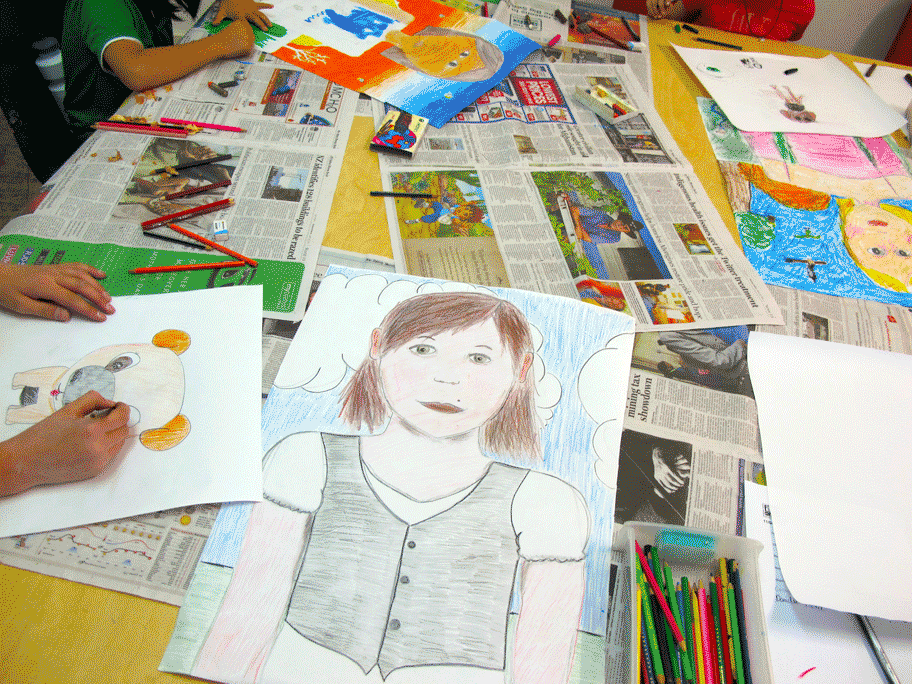
Our first week of holiday workshops is already over and the students have been making some really colourful and creative images. In the Portrait - Drawing & Painting class, teacher Laura Carey had the children experimenting with various mediums such as coloured pencils, thick waxy crayons and paint to create a range of tones and textures in their drawings. With the subject of their pictures the portrait, the students were encouraged to think about proportions of the face and how the nose, mouth, eyes, cheeks.ears etc are related to each other in regards to space on the head.


The photo above shows the students work in progress, with those finishing early gettting to draw other favourites.

As you can see from the portrait below, the tones from the waxy crayons were much richer and darker than those from the coloured pencils. These contrasts add to the images complexity and becomes visually interesting. You can see more portraits and works from the classes by going to our flickr site.


There are only a few spaces in the classes for next week, so please go to our website to check these out.

Laura Carey will be teaching the Paper Mosaics Class and the Animal Masks which will all include working with coloured papers, pencils, paints and a range of mediums for some exciting results.